Brisbane, QLD


Monday, July 22, 2013

HAPPY CAMPERS

From Weipa we travelled east, back to the main road north. We took a short cut through Batavia Station, a huge property which has been given back to the traditional owners but they gave us permission to travel on a rough road through the property.
We travelled most of the day through Savannah type country and we arrived in the afternoon at Moreton Telegraph Station our next overnight stay. We were  following the route of the old telegraph wires again from Cairns to Thursday Is. Camps and later buildings (telegraph station) were made along the track as depots for materials to build the original tracks for the poles and wires.

"Moreton Telegraph Station was completed in 1887. All the stations were built like forts to protect staff and equipment from "wild blacks". Buildings were constructed of heavy gauge galvanised iron and on two diagonally opposite corners a protruding 'turret' was built with gun ports allowing each an uninterrupted view along two side as well as forward. All windows were fitted with iron shutters which could be bolted from within." Mr Google.

110 years later the stations were no longer used as telegraph stations and some of them have become tourist destinations with camp sites and cabins. 

 This is another open air dining room. We were to sleep in the permanent tents.........

but we were upgraded to cabins with en suites. Hooray. The happy campers are: TOH*, me, George and Ann. Check out TOH's shirt..it says "DON'T DRINK AND BLOG"

 The cabins were very comfortable considering we were in the middle of the isolated Cape York Peninsula.

 Before dinner, Chris, our driver/guide took us for a walk to the river called the Barra Hole as it was where there are many Barramundi Fish. (A favourite Aussie fish).

 We saw native figs growing called 'bush tucker' 

 We climbed over rocks and down a steep bank to the river (watching out for crocs on the way). This river rises 16 m in the wet season. We saw flood debris hanging in branches way up high in the tall trees.

On the way back to camp we passed through fields of tall grasses. This one is dangerous for sheep. Its common name is Corkscrew Grass.  It has unusual barbs or seed spears. When they get wet they start to twist and turn like a corkscrew and drill down into the soil to grow again.

Can you see the spears? Sheep cannot be raised here because these corkscrew seeds get caught in their wool and when it rains the seed screws down into the sheep's skin and body, causing severe pain and infection and death.


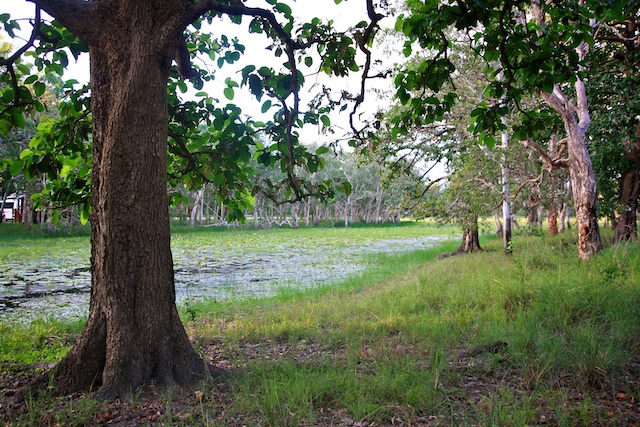
We passed a pretty billabong (water hole)

Then I spied a beautiful tree covered in red flowers. There was a Blue Faced Honey Eater having its dinner and we were soon eating ours too.
*(TOH = The Other Half)

Saturday, July 20, 2013

WARLIKE WOMAN

This weeks Sepia Saturday theme is " Boadecea or Mother England’ or possibly Britannia. You can choose; or go with armour, helmets, shields, fancy dress, pantomime, theatricals, warlike women or big sticks".
I rummaged through my box of old photos and couldn't find anything resembling a warlike woman except for these shots of me playing competitive sports with a weapon.
 
 When I went to Papua New Guinea as a teacher in 1963, I joined sporting clubs to make friends. The first club was the Pt Moresby Archery club. I really enjoyed this sport. The equipment that I see now days is so high tech compared to what we used then.
Later I gave up archery because I joined a hockey team. Hockey was my favourite sport and I had played since I was 13. However, it was extremely hot playing in the hot, humid, tropical weather. The Papuan girls could really slog the ball hard.

Thursday, July 18, 2013

BIG BAUXITE MINE

We drove on and on through Savannah country towards Weipa on the west coast of Far North Queensland. It is the site of the biggest bauxite mine in the world. It is the biggest town on Cape York Peninsula with a population of 3,500. We visited the mine and I was amazed at the industry.

 Before we reached Weipa we stopped at a tiny country town of Coen with just one main street. All the town residents were dressed in their best and heading for the open air community hall because the Governor of Queensland (Penelope Gibson) was in town on her way to Weipa to unveil a plaque to commemorate the landing of the Dutch on the west coast of Qld. I wonder what she thought about the name change of the hotel opposite her function. It is no longer the Exchange Hotel as someone added an "S" to the front. (see it on the roof.)

After morning tea in Coen we drove on and on further to Archer River Roadhouse for lunch. It is a popular stop for tourists as it is the last place for petrol if going straight up to the tip of Oz. However, we were detouring across to Weipa first. The road goes through the Archer River but on a concrete ford. We were standing on the concrete watching this silly photographer walking into the croc infested river. We yelled at him about the crocs but he didn't believe us. Lucky for him none appeared.

Finally we arrived at Weipa. we stayed at the Albatross Resort which was really a country pub but it had a great view of the Gulf of Carpentaria. Once again we were reminded to be croc wise while walking. That means stay off the beach. It is a bit sad not being able to enjoy the beaches up there.
Not only do they have crocs but when we arrived at our room, there was a snake trying to get under the door. A staff member came and swept it away and it slithered into the garden. The insects and bugs are also on steroids up there.


The next morning we met a local tour guide who drove us through the Rio Tinto Alcan Bauxite mine. We were not allowed to get off the bus for safety reasons so all the photos are through the windows.
The haul roads are specially built for these humungous trucks, which are also specially built for this type of mining and they are much larger than normal mining trucks.The roads are as wide as a 4 to 6 lane highway.

Bauxsite mining doesn't have pits or tunnels the bauxite is just scraped off the top. Firstly the trees and top soil are removed and then the red bauxite ore is loaded onto trucks and taken to the treatment plant.
The Bauxite ore is made up of little round red pebbles like ball bearings you can see it at the bottom of this pic. When they have finished, the miners replace the top soil and plant the same type of trees that were there. We saw regenerated areas and they looked good.

 Loading the truck with bauxite ore. They are a long way off and it is hard to tell how huge are these machines.

The trucks bring the ore here where the ore is washed and then goes on a conveyer belt to a train. See the truck at the top it is waiting for its turn to dump the load into the treatment plant. It tips the load sideways out of the truck. These trucks work non stop 24 hours a day every day. The mine produced 16.3 million tons (2009).
 The conveyer empties the ore into a funnel which feeds it into the train wagons which are operated by computers to move slowly along at the right speed for the wagons to be filled. The trains take the ore to the wharf not far away.

The ships take some ore to Gladstone alumina smelters on the Central coast of Queensland where it is turned into aluminium.  The rest goes  to overseas customers.

I'm not sure what these huge road trains are used for. There were six of these monster trailers hanging on the back.
Bauxite was discovered in Weipa in 1955 and production started in 1964 and it has been producing non stop for the last 49 years. There is enough ore here to mine for another 40 years. The Rio Tinto lease covers an area of 3,860 square kilometres. The land is owned by different aboriginal councils. The Land Use Agreement provides economic, education and employment benefits as well as cultural heritage support. It was a most informative, interesting tour.

  Then it was lunch time, we had a picnic on the shores of Patricia Lakes. Ann enjoys the view.

At last I found a Cooktown Orchid, which is Queensland's floral emblem.

Monday, July 15, 2013

HALF WAY THERE

After lunch at the Hann River Roadhouse we continued on our trek to the tip of Australia. We rumbled along the dirt roads for miles and miles passing through cattle stations the size of small countries. We came to a smidgen of civilisation.

It was the Old Musgrave Telegraph Satation which was opened in 1886 and it was the half way telegraph station between Cairns and Thursday Island just off the tip of Australia. It operated for 100 years as a telegraph station. Now it is a hotel, shop and museum as well as a Flying Doctor Clinic.
 Our driver exclaimed, "There must be something happening here today. I have never seen so many people here before."(there was about a dozen). Then he saw the Flying Doctor's plane on the station's airstrip. Later we found out that it was clinic day, where people from outlying stations drive in to the station to see the doctor. The Royal Flying Doctor Service is a unique aero medical organisation which delivers emergency services and clinics in an immense area of sparsely populated Australia. The aircraft are equipped to provide airborne intensive care. Doctors, nurses and pilots are on call 24 hours a day. The Cairns base is the biggest in QLD and covers an area the size of Japan.

The children from outback stations come in to see the doctor wearing their good clothes except you can't keep country kids in shoes. These children probably only see each other occasionally. They do their schooling from home by "School of the Air" which used to be done by radio but now uses computers with an interactive two way broadband satellite connection.

 The children were waiting to wave goodbye to the doctor as he flew over their heads back to Cairns base.
There was another little plane just taking off after dropping off a patient who had been to Cairns for cancer treatment. The patient was actually Sue, the owner  of Lotus Bird Lodge where we would be sleeping that night. This plane belonged to a different organisation called Air Angels . They are privately owned planes of cattle station owners who donate the planes (when not in use) to take non emergency patients for treatment.

We followed Sue for a long way until we arrived in the late afternoon at Lotus Bird Lodge, another nice accommodation place in the middle of nowhere. There were a series of cabins situated on the edge of a lagoon.

 Before dinner we went for a walk around the lagoon. It is usually inhabited by many birds but we only saw a few. 

However it was a very pretty walk with the setting sun lighting up the trees.


We had a delicious home cooked meal in the open air dining room. We watched the kangaroos come in for a nightly feed of seed put out by the owners. There were 19 of us on the bus and we were the first  guests for this dry season. The Lodge is closed in the wet season like most other tourist destinations as the roads are impassable in the wet. This lodge was almost completely ruined in floods some years ago and had to be renovated.

 The next morning all the staff waved us goodbye. Gary and Sue were wonderful hosts and three young  girls who come from Sweden each season to work there. Gary and Sue regard them as family.
Weipa, on the shores of the Gulf of Carpentaria, was the next overnight stop.

Sunday, July 14, 2013

OLD PHOTOS

I love old photos. 
This is my mum and dad somewhere in England in the 1930's, I'm guessing. They appear to be on a beach. I love that my mum has bare feet but my dad had a raincoat on.

 This is one of my mother in the 1920's somewhere in England. Actually on the back it says A.Anning, Valley Drive, Ben Rhydding, Ilkley, Yorkshire. She is the one with a towel like a cape.  I think she is with school friends in their modern swim wear of the times.

Saturday, July 13, 2013

QUINKAN COUNTRY

After 2 nights in Cooktown we headed north west towards Weipa on the west coast of Far North Queensland. We stopped in the small town of Laura for morning tea but first we were taken to see the art of the Quinkan Region. UNESCO rate this region as one of the top ten rock art areas of the world. Aboriginal occupation of this area dates back over 37,000 years.

Our local aboriginal guide, Roy, hiked us up a steep escarpment to overhanging rock shelters. He called out to the Quinkan spirits to let them know we were coming.
"Split Rock"track led us up to the top of the hill.

 Roy explained the motifs to us. There are many of these painted caves in this area


 The view from up here was great but then we had to negotiate the descent.

 TOH did well to climb this hill in the tropical heat. He was looking forward to the coffee waiting for us at the bottom, which the driver had prepared from the bus.
Down, down, down.

 We drove into Laura and visited the Quinkan Cultural Centre.  I love the aboriginal art.

The store where we bought our ice cream had this old Austin car in their yard. It is an identical model of the first ever car to drive to the tip of Australia back in the early 1900's. How they did it is mind boggling as the roads were just dirt tracks through the bush, swamps and creeks.

Next stop was the Hann Roadhouse for lunch. These places are so isolated. It is miles and miles to the next town.


The road house had a variety of tame animals. This emu was coming at me to say hello but I wasn't too sure about that muddy beak and what he might do with it.


One of the tourists shared her ice cream with a friendly Rainbow Lorrikeet. 

Back in the bus we drove through the river and we were on our way further north.