Brisbane, QLD


Showing posts with label Armidale Trip May 2021. Show all posts

Friday, May 28, 2021

ARMIDALE TRIP-GOTSWYCK CHAPEL AND DANGARS FALLS (Day 3 cont.)

 After lunch on the third day we set off to see Gotswyck Chapel or more properly known as 'All Saints Anglican Church.' It was built in 1921 by the widow of Clive Dangar (1882-1918) who was killed in WW1. It is a tiny chapel standing all alone in the country. It is actually on private property.

Unfortunately we couldn't go inside. It has to be kept locked and under security cameras to prevent vandalism.(such a shame).

The name Gotswyck refers to Gotswyck Station (ranch) that has been owned by the same family for five generations since 1834. Originally owned by Edward Gotswyck in 1833 it was quickly sold to Henry Dangar. It was 48,000 acres and he ran up to 120,000 sheep. Early workers were mostly convicts. The property is smaller today (13,000 acres) but still in the Dangar family.

 This is the driveway to the Gotswyck Homestead and Bill taking a shot of the chapel. I couldn't help thinking how beautiful this driveway would be when the autumn leaves still adorned the trees.

Then we set off to see the Dangars Gorge and falls named after Henry Dangar.

Dangars Gorge is in the Oxley Wild Rivers National Park. You must remember that Australia is the driest continent in the world so you don't see much water in these gorges unless it has been raining for a while.

We walked to the first lookout from the carpark. It wasn't a good angle to see the falls. There was a little bit of water falling 120 m to the bottom of the gorge. 


At the bottom there were a series of water holes with little waterfalls connecting each one.

Val and I left the boys in the carpark and ventured further down the trail. We went down and down to reach the top of the falls. We were a bit worried that it might be too steep for us to get back up.

Looking over the top of the falls from a secure lookout.

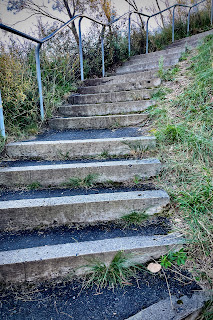
We took it slow and steady and finally got back to the car. It bought on a bit of asthma for poor Val.

Tuesday, May 25, 2021

TRIP TO ARMIDALE (day 1 and 2)

 Last week we did a road trip to Armidale in the Northern Tablelands of New South Wales. It is 1000m above sea level. This area is called New England because it has the four distinct seasons and Autumn leaves. This is why we went there, to see the Autumn leaves. Unfortunately, we were too late, most leaves had fallen.


On the way we stopped at Glen Innes and visited the Australian Standing Stones. The Standing Stones began as an idea of a small group of people who wanted to mark Glen Innes' Celtic heritage, where the first settlers mainly Scots arrived in 1838. In our bi-centenial year 1988, the Celtic Council of Australia developed the idea of erecting a national monument to honour all Celtic peoples who helped pioneer Australia. The Standing Stones was inspired by the Ring of Brodgar in Scotland. See more detail on a previous post here.


It was great to be out of Brisbane City and in the countryside.
We arrived at our motel in the evening. It was cold about 3°C but the host had turned on the heat for us. The next day we took a small bus tour of the heritage sites and attractions in the city. There are only 24,000 people living in Armidale but it's called a city because it has two cathedrals.

Most leaves had fallen.

We stopped at the Aboriginal Cultural Centre. It wasn't long before the old boys found a seat in the sun, while Val and I looked at the exhibition.

We called into the New England Regional Art Gallery where we saw the Hinton Treasures of Australian Art. Howard Hinton OBE donated over 1000 artworks between 1929-48 including works by leading artists of the time. Now it is one of the most significant collections of Australian art. I liked the old masters but I fell in love with the rhino made from old clothing stuck onto a wire frame.
Booloominbah Homestead
Next stop was in the grounds of the University of New England. Armidale is famous for its University and Churches. New England University was the first university established outside a capital city. The original property was presented by TR Forster. It comprised of the Booloominbah Homestead, other buildings and 74 hectares of land. It now comprises of 260 hectares. The homestead was designed by John Horbury Hunt in the Federation Arts and Crafts style in 1884-88. Originally the private home of the rich pastoralists, the White family. White's granddaughter, Sarah, lived there for many years. She was married to TR Forster, who donated it to the university. It is now used for administration, functions and cafe (closed due to Covid).

That evening we went to the recently renovated Tattersals Hotel for dinner.  We are with our travel companions, Val and Peter.
It was delicious!