I was in the forest with my walking buddies, Helen, Joan and Maureen, when we saw a koala trying to climb a dead tree. He looked very weak and sick. They usually scamper up a tree quite quickly but not this poor little guy.


My friend , Joan, took the next photos of the rescue by John. John had a long pole with a plate like top to it. He puts it gently over the Koalas head and encourages it to climb down.
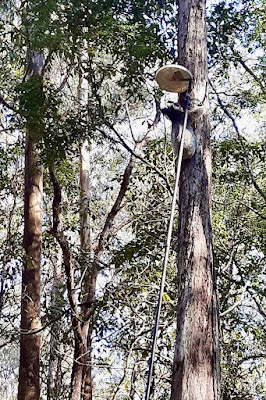

Down he comes. John wears long, thick protective gloves because koalas have very long, strong claws that can cause damage when they are frightened and attack.

John grabs koalas' arms and drops him in the cage.


Poor Bobby had very sore eyes. They were bright red. We are not confident that he will survive.
Koalas are in decline due to many reasons: clearing of their habitat for buildings, bushfires, dog attacks, hit by cars and chlamydial disease.
This article is from Oxford Academic:
Chlamydia pecorum is classically associated with ocular and urogenital disease in koalas. When the infection establishes in the conjunctiva of the eye, chronic conjunctivitis and keratoconjunctivitis can lead to corneal scarring and eventual blindness. When the infection establishes in the urinary tract (including the urethra, bladder, ureters and kidneys), the accompanying urethritis, cystitis, ureteritis and/or pyelonephritis can cause severe pain, polyuria and/or urinary incontinence leading to “wet-bottom” as well as skin ulceration and secondary infection. Finally, when infection establishes in the reproductive tract, inflammation in both females (eg. salpingitis, endometritis, vaginitis) and males (eg. epididymitis, orchitis, urethritis) can lead to scarring and infertility.


